FPV Wireframe may earn an affiliate commission if you purchase gear through our links, with zero added cost to you. Read our retail affiliate and referral disclosure
FPV cameras are the visual link between your hands and the drone—they need to be light, responsive, and reliable. For micro racing builds and tinywhoop platforms, weight directly affects flight performance, while video quality and latency determine how well you can see the course and react to obstacles.
The three cameras below represent the main approaches available: budget-friendly analog with internal OSD (on-screen display), a middle-ground hybrid option, and an ultra-lightweight digital setup. Each brings different tradeoffs in price, video fidelity, and voltage requirements.
What matters in a micro FPV camera
Weight. Racing builds and tinywhoops operate on tight power budgets. A camera that weighs 1–2 grams versus 7 grams changes how your quad accelerates and how long your battery lasts.
Sensor and resolution. Most micro cameras use 1/3-inch CMOS sensors and range from 800 to 1500 TV lines. Higher TV lines give sharper detail but don't guarantee better low-light performance.
Voltage range. Micro builds use single-cell (3.7V nominal) or multiple-cell batteries. Cameras specify their operating range; mismatched voltage can damage the camera or cause flickering.
Aspect ratio flexibility. 16:9 (widescreen) and 4:3 (standard) aspect ratios suit different flying styles. 16:9 gives more horizontal field of view; 4:3 preserves detail in the vertical plane.
Latency. Analog video has inherently lower latency (typically 1–5ms) than digital systems, which matters for tight racing gates. Digital cameras can deliver cleaner signal in interference-heavy environments.
Three lightweight options
Pinout definitions and voltage tolerances are listed per seller claims. Review open-source firmware targets before wiring to flight controllers.
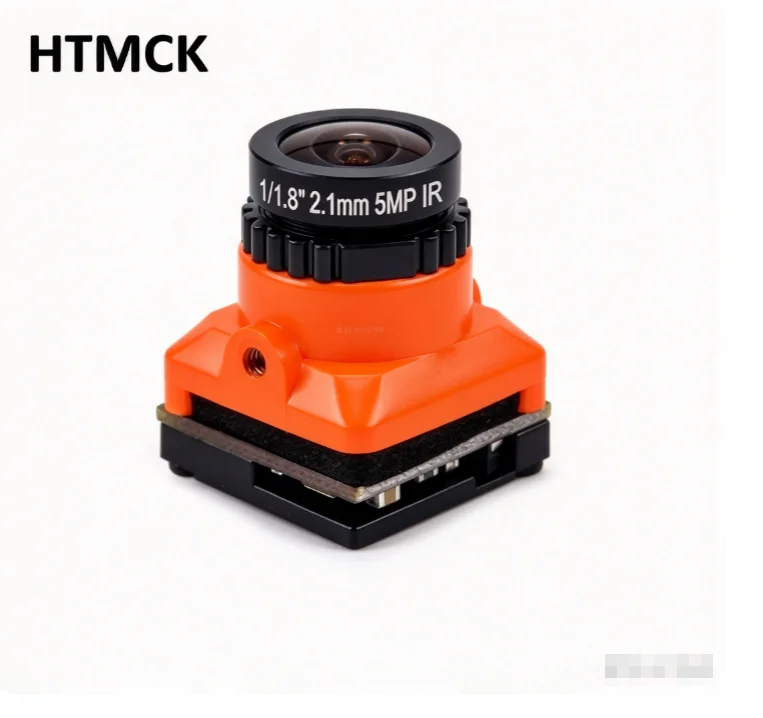
The HTMCK Mini is the budget entry point. Its 1500 TV line resolution matches pricier options, and the 2.1mm lens provides a 160° field of view in 4:3 ratio. Advertised voltage range spans 5–30V, which covers 1S through 6S battery packs. No weight is specified in the listing, so you'll want to verify the exact gram count before committing to a weight-critical build. The internal OSD menu suggests switchable PAL/NTSC modes. At $14.85, it's designed for pilots who prioritize affordability over features.

Pinout definitions and voltage tolerances are listed per seller claims. Review open-source firmware targets before wiring to flight controllers.
The RunCam Phoenix 2 SP V3 occupies the mid-tier. At 7.5g, it's noticeably heavier than nano options but still light enough for cinewhoops and slightly larger racing quads. The camera supports both 4:3 and 16:9 aspect ratios—a useful flexibility if you're experimenting with different flying styles. Voltage compatibility spans 5–36V, accommodating most battery configurations. The listing mentions "Night View," though the specifics of that feature (lens type, sensor enhancement, or software processing) aren't detailed. Dimensions are given as 19×19×21 mm. At $41.79, it commands a premium over budget analog but stays below premium digital systems.

Pinout definitions and voltage tolerances are listed per seller claims. Review open-source firmware targets before wiring to flight controllers.
The CADDX ANT Nano sits at the ultra-light extreme. Independent testing describes it as weighing about 2g, making it ideal for weight-sensitive builds like the Mobula6, Toothpick frames, and cinewhoops. The 1.8mm lens and 1200 TV line resolution represent the tinywhoop standard. The camera offers both 16:9 and 4:3 ratios and includes a Global WDR (wide dynamic range) feature to handle bright outdoor lighting. The listing indicates an integrated OSD. Voltage range is not specified in the listing provided—you'll need to check the product page or manual to confirm it matches your battery voltage. At $19.05, it bridges the gap between the budget option and the mid-tier camera.
A note on availability: These listings appear on AliExpress as of November 2026. Pricing and stock are subject to change. Shipping times and delivery eligibility vary by region; confirm your location and destination at checkout.
Analog vs. digital: Which approach?
The three cameras here use analog video transmission. Digital FPV systems like HDZero deliver 720p resolution and stable color reproduction, but they require compatible digital goggles and video transmitters—a bigger ecosystem investment. Analog remains the standard for micro racing because it works with cheaper goggles and transmitters, has lower latency, and uses less power.
Voltage compatibility checklist
Before purchasing, confirm your quad's battery configuration and the camera's voltage range:
- 1S (3.7V nominal): The HTMCK Mini and RunCam Phoenix 2 SP V3 both support this range. The CADDX ANT's voltage spec is not listed—check the manufacturer documentation.
- 2S–4S (7.4–14.8V): All three support this range.
- 5S+ (18.5V and up): The HTMCK Mini and RunCam Phoenix 2 SP V3 handle this. The CADDX ANT's upper limit is unclear.
Plugging a camera into the wrong voltage risks immediate failure or shortened lifespan. When in doubt, consult the camera's manual or the seller's FAQ before connecting power.
Which camera for your build?
Budget and simplicity: The HTMCK Mini at $14.85 suits pilots who want basic FPV without spending much. Verify the weight before assuming it fits tight builds.
Flexibility and proven durability: The RunCam Phoenix 2 SP V3 works well for cinewhoops and larger racing quads where the 7.5g weight isn't a constraint. Its dual aspect ratio option lets you adapt to different flying preferences.
Ultra-light racing: The CADDX ANT Nano is the logical choice for tinywhoop frames and weight-critical builds. The 2g weight makes a measurable difference in acceleration and flight time. Confirm voltage compatibility with your specific battery pack before ordering.
All three use common FPV connectors and integrate with standard VTX (video transmitter) modules. None includes a transmitter or goggles—you'll need those separately. See Budget FPV Goggles: 008D Box Headsets for Racing Drones if you're building your first FPV system from scratch.
```Evaluation is based on published specifications and seller listings. No physical or hands-on testing was conducted; unlisted specifications may still be available from the seller.